Part 1: What are Stocks, Different Types of Stocks

Part 2: Why Invest in Stocks, Why Stock Prices Go Up & Down, Who Should Invest in Stocks

Part 3: Things to Remember When Investing in Stocks, How Can You Invest in Stocks

Introduction to Stocks for Kids and Teens

This video explains the concept of stocks in a simple, concise way for kids and beginners. It could be used by kids & teens to learn about investing in stocks, or used as a money & personal finance resource by parents and teachers as part of a Financial Literacy course or K-12 curriculum.
Suitable for students from grade levels:
- Kindergarten
- Elementary School
- Middle School
- High School
Table of Contents
Interactive Learning Experience: What are Stocks?
Stock Market Adventure is an engaging educational game designed to introduce young learners to the fundamentals of the stock market.
Through a series of interactive mini-games and levels, users learn key concepts like stock types, company classifications, and the importance of diversification. A friendly “Finance Guide” character provides simple explanations and encouragement at each stage of the learning journey.
This interactive learning app makes financial literacy approachable and enjoyable for kids and teens, turning complex topics into a fun, hands-on adventure.
Books by Easy Peasy Finance

[This is an affiliate link: at no additional cost to you, we will earn a commission if you click & make a purchase]
Quiz: What are Stocks?
[tqb_quiz id=’46170′]
Infographic: What are Stocks?
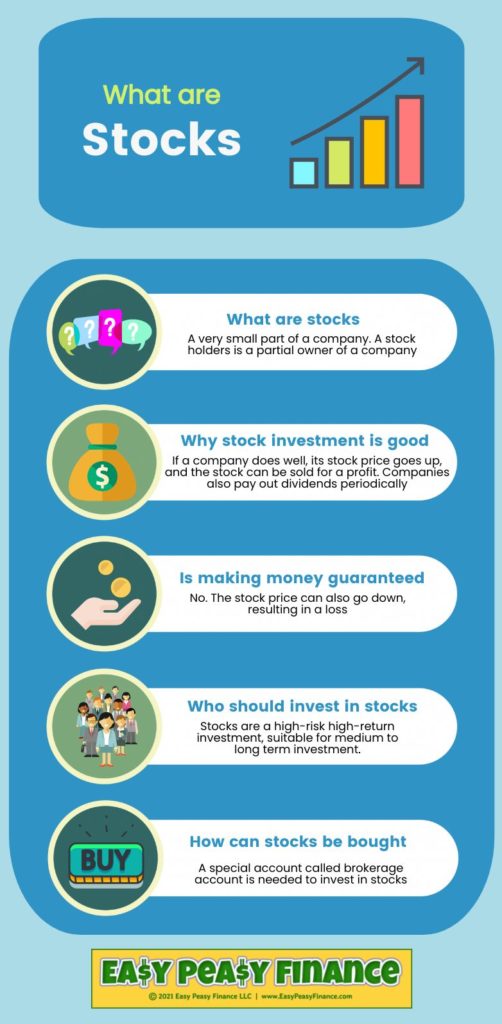
Infographic: Click Here to Download
What are stocks?
Stocks, also called equities, are one of the most popular types of investments.
When you buy a company’s stock, you’re buying a small piece of that company, which makes you a shareholder. This means you have a claim on the company’s assets if it goes bankrupt in proportion to the stock you own.
Shareholders get privileges such as voting on the company’s decisions, and a share of the company’s profit in the form of dividends.
Companies issue stock to raise capital for various purposes, such as expanding their operations, launching new products, or refinancing debt.
Stocks are traded on stock exchanges (like the NYSE or NASDAQ in the US), and their prices fluctuate based on various factors. As the value of the company rises or falls, so does the value of its stock.
Are there different types of stocks?
There are two main types of stocks.

Common stocks are the most popular. They give shareholders voting rights and dividends. However, if the company declares bankruptcy, common stockholders are the last ones to get paid.
Preferred stocks are like a combination of common stocks and bonds. Preferred stockholders usually don’t have voting rights, but receive fixed dividends. They are also paid before common shareholders if the company goes bankrupt.
The most important difference is that common stock is riskier but has a higher profit potential. Preferred stock is safer but the upside is limited.
Stocks can also be classified as growth, value or income stocks.
Growth stocks are expected to grow at a much faster rate than the market average. People buy them for a higher capital appreciation, for example, tech startups.
Value stocks trade at a price lower than what they are worth. Investors find value in investing in them as they are bound to appreciate in the future since the company’s fundamentals are strong. For example, a stable, well established bank.
Income stocks – also called dividend stocks – are companies that pay regular dividends. They are seen as a steady and predictable source of income by investors. For example, an established utility company.
Why do people invest in stocks?
People invest in stocks with the intent to earn money either in the form of dividends or capital appreciation.
Dividends are a portion of the company’s profit that’s distributed amongst its shareholders.
Capital appreciation is the gain you make when you sell your stock at a higher price than you bought it for.
What causes stock prices to go up or down?
Many factors influence stock prices, including economic trends, market conditions, interest rates, investor sentiment, and unforeseen events such as natural disasters.
However, the most important factor influencing stock prices is the company’s performance. This happens because of demand and supply: investors will buy stocks of companies that do well and sell stocks of companies that do poorly.
Therefore, if the company does well: it has growing revenue, market dominance, and high profits, the stock price will go up. But if the company does badly: its revenue decreases, it has increased competition, and profits are low, the stock price will go down.
In general, the stock market tends to go up over the long term.
Who should invest in stocks?

Stocks are a high risk, high reward investment that are ideal for medium to long term investment. So you should only invest in stocks if you have at least 7 years before you plan to sell.
Those who are just starting out in their career and are saving for a long term goal like retirement, can absorb and recover from any losses before they need that money. This makes them ideally suited for stock investments.
People approaching retirement or those who have expensive goals like a wedding or buying a home, coming up in a couple of years should avoid stocks and instead opt for less risky investments like bonds, certificate of deposit (CD), etc.
What should I keep in mind when investing in stocks?
It’s important to understand that while stocks have a huge profit potential, investing in stocks does come with a risk of losing money. This is why it’s crucial to do thorough research before investing in any stock, and be prepared for ups and downs in the near term, which is called volatility.
It’s also important to have diversification – don’t invest all your money into just a handful of stocks. Instead, spread your investments across different companies and sectors – and if possible even geographies – to minimize the risk of losing money.
For instance, in one year, the technology sector might experience record profits while the automobile sector might be experiencing a loss. But this could completely change the next year.
Diversification allows you to enjoy the gains while minimizing any losses.
Despite short term fluctuations, stock investments in good companies tend to do well over time.
So have patience, be disciplined and invest for the long term. Don’t be impulsive, react emotionally to market volatility or get swayed by tips, hot stocks, meme stocks, etc.
Also, as a common stockholder, you need to be prepared that in case of the company’s bankruptcy, you may not get anything since you will be the last in line as the assets are liquidated.
How can I invest in stocks?

You can invest in a company in the primary market when it first goes public through an IPO or Initial Public Offering. After this, it is available for trading on a stock exchange like the NYSE or NASDAQ, which is called the secondary market.
There are 2 main ways to invest in stocks in the secondary market.
The first is direct ownership, where you buy stock of an individual company through your brokerage account. Most online brokerages no longer charge fees for buying and selling stocks.
While this makes direct ownership easier, it’ll need a lot of money and involve a lot of research if you want to achieve the necessary diversification.
An easier approach, especially for beginners but really for everyone, is to invest through a mutual fund (MF) or Exchange Traded Fund (ETF).
What makes it even more effective is investing in a fund that tracks a broad based index like the S&P 500. This way, you get instant diversification of investing in 500 different companies at a fraction of the cost and without any hassle of researching, tracking, buying and selling individual stocks.
If you want to start investing in stocks now, check out Start Investing in 7 Easy Steps: A Guide to Begin Investing Today for Kids & Beginners
What are Stocks: Old Version

Howdy Wall Street Willy! I have a really big question for you.
Yes, what is it?
What is a stock?
Well, a stock is basically a very small part of a company.
Well, what do you mean?
So if I buy stock, I own a company?
No, you do not own the whole company – you own part of the company.
So, do I own part of a company if I buy one little baby tiny stock?
The answer is yes, you do own part of the company if you buy one little tiny baby stock.
I have another question.
Why would I want to buy a stock?
Well, you would want to buy a stock because if this company that you buy the stock in does well, then, the stock price – which is how much you bought it for – will go up.
Well then, if the stock price went up from what I bought it for, then do I make money?
No, you do not make money actually.
Well, why is that? Then what’s the point of buying a stock?
Well, if it goes up, then you have to go to your brokerage account, then sell it, and after you sell it, you get the money that its now trading for or selling for. That way, you can make money.
Or, if the stock price went down or the company didn’t do well, you might lose money. But that’s ok because stocks are a risk, and you could make a lot of money.
Okay, now that’s real good!
So I could make a lot of money no matter what?
No, if the company stock goes up in value, then you can make a lot of money.
Oh, ok. Very good.
But how do I know how expensive one stock is?
Well, you can look online on Yahoo Finance or any other brokerage site to find out how expensive any stock is.

Oh cool.
But where can I buy a stock?
You can buy a stock online.
Well, then how do I find the exact stock that I’m looking for?
Each stock has a specific stock symbol. That symbol is only entered for that stock.
So, let’s say I’m starting a company called Fun Time Party Places. I would choose a symbol for my company that is FTPP.
Then, if you entered FTPP, then you would find the share price or stock price of my company’s one stock.
Cool! But where can I buy a stock?
You can buy a stock online from your brokerage account.
What’s a brokerage account?
Well basically, you can’t buy a stock right out of your bank account.
You need to transfer your money into your brokerage account because the brokerage account has special brokers that make the transaction for you or buy the stock or sell the stock for you.
Whoa, that’s cool!
But do I have to pay the person who makes the transaction extra?

Yes, you do. The extra amount that you pay them is called a commission. The commission us usually $7-$10 per stock. Well, not really per stock, but for every amount of stock from one company.
For example, if you buy one stock of my company that I started, you would have to pay $7-$10 in the commission. But even if you bought a 1,000 stocks of the same company, you have to pay the same commission.
But, if you buy one stock of my company and another stock of a different company, you have to pay a commission for buying my stock and the other person’s stock because they are part of different companies.
Cool. Well then, if I buy the company’s product, do I own one stock automatically?
Well no, you don’t, because you are not paying to buy the stock or paying a commission.
Okay, now that all makes sense. Thanks a lot for showing me what a stock is!
You’re welcome!
Remember, finance is your friend!
Frequently Asked Questions (FAQs)
What exactly is a stock?
A stock (or equity) represents a small ownership share in a company, making the buyer a shareholder with a claim on its assets and profits.
Why do companies issue stock?
Companies issue stock to raise capital for various purposes like expansion, launching new products, or refinancing existing debt.
How do investors make money from stocks?
Investors earn money through capital appreciation (selling at a higher price) and dividends (a share of the company’s profits).
What makes stock prices fluctuate?
Stock prices are mainly driven by a company’s performance, which affects demand and supply, alongside broader factors like economic trends and investor sentiment.
What is an ideal time horizon for stock investing?
Stocks are ideal for medium to long-term investment, specifically if you have at least seven years before you plan to sell.
What does “diversification” mean in stock investing?
Diversification means spreading investments across different companies, sectors, and geographies to minimize the risk of significant loss.
What is an index fund and why is it recommended?
An index fund (like one tracking the S&P 500) provides instant diversification across many companies with minimal hassle and lower cost.
Video Featured in the Below Financial Literacy Courses for Kids and Teens
Download Transcript: Ideal for Use by Teachers in their Lesson Plan to Teach Kids and Teens
Podcast: What are Stocks?
Fun, informative and concise episodes by a 16-year old, breaking down complex financial concepts in a way that kids and beginners can understand. Episodes cover personal finance topics like saving, investing, banking, credit cards, insurance, real estate, mortgage, retirement planning, 401k, stocks, bonds, income tax, and more, and are in the form of a conversation between a cowboy (a finance novice) and his friend, a stock broker. Making finance your friend, only at Easy Peasy Finance.
A little bit about me: I have been fascinated with the world of personal finance since I was 6! I love to read personal finance books, and keep myself updated on the latest by reading various personal finance magazines. My friends often ask me questions about finance because they find it complex and intimidating. That’s what inspired me to start my YouTube channel called Easy Peasy Finance when I was 8, and this podcast 2 years later.
Everything you would want to know about stocks – what stocks are, the concept of company ownership, why you should buy stocks, where and how you can buy stocks, brokerage account, commission, etc. Show notes and transcript at: https://easypeasyfinance.com/what-are-stocks/