Personal Finance Education and Financial Literacy for Kids & Teens is Critical – Here’s Why
Did you know?
- 50% of American households live paycheck to paycheck
- 44% of Americans don’t have enough cash to cover a $400 emergency expense
- The average American household’s credit card debt is $5,700
- A third of Americans have saved nothing for retirement
- 80% of Americans’ retirement plan is to keep working
Sources: MarketWatch, Money, Employee Benefit Research Institute, Value Penguin
Not convinced that financial literacy and finance education for kids and teens is important? Watch the video, or read on!
Infographic: Click Here to Download

What’s the number one reason for stress among adults? It’s money – how to earn more than they spend, how to save, invest and retire debt-free.
Most people spend a good amount of their adult life worrying about money because they don’t start learning about money management until they are faced with the financial realities of life.
That’s why, it is crucial to teach kids about finance well before they need to start making financial decisions. You can run from your money problems, but you can’t hide!
Not convinced?
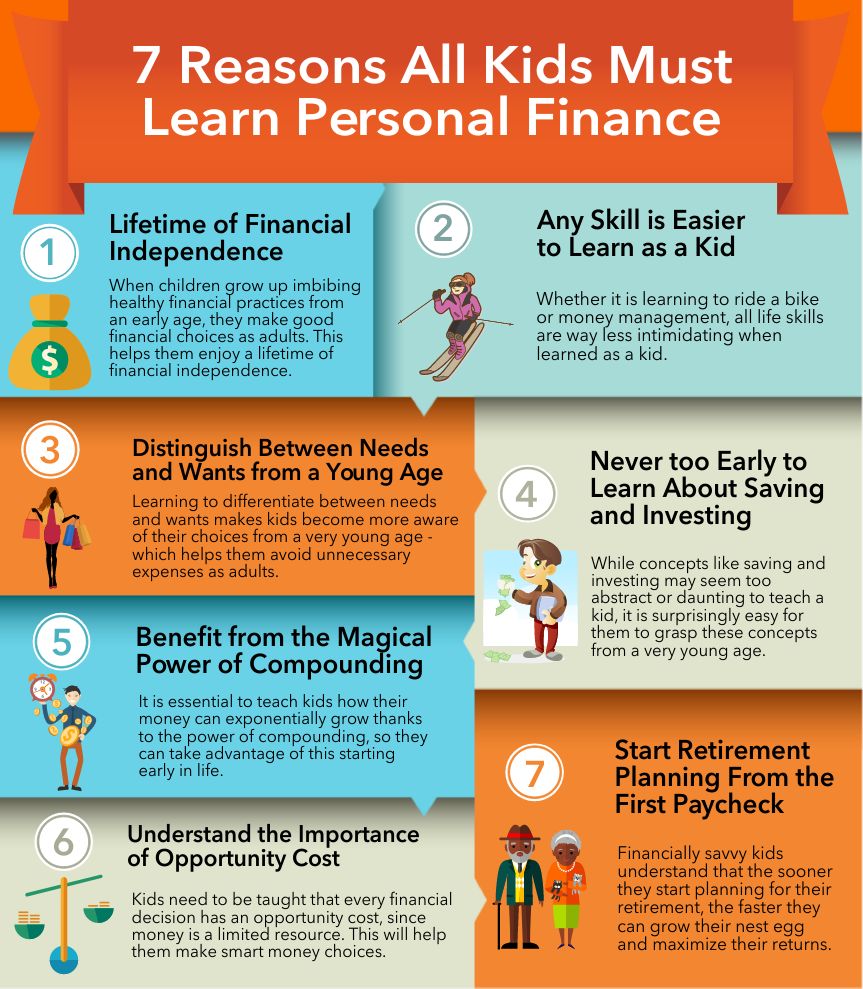
Here are 7 reasons why financial literacy for kids is important, and why ALL kids should learn about personal finance and what they need to know to grow up to be financially savvy adults.
1. Any Skill is Easier to Learn as a Kid

Don’t you agree? How many of us wish we had learned skiing or skating when we were just carefree kids?
Especially when we see those tiny tots zooming past grown-ups who are consumed with the fear of getting injured!
Whether it is about learning to ride a bike or money management, all life skills are way less intimidating when learned as a kid.
2. It’s Crucial to Distinguish Between Needs and Wants
Good financial habits start by being able to distinguish between what is a “must-have” and what is a “nice to have”.
Think about it for a moment – in today’s world of extreme consumerism, need for instant gratification, and social media bombardment of “must-haves” that we otherwise had no clue about, would you really blame people for their spending habits which send them into a dizzying downward spiral of debt?
By teaching kids how to differentiate between needs and wants, they become more aware of their choices from a very young age. And who wouldn’t want their kids to be conscious consumers – we all know expensive habits are hard to change.
Books by Easy Peasy Finance

[This is an affiliate link: at no additional cost to you, we will earn a commission if you click & make a purchase]
3. It’s Never too Early to Learn About Saving and Investing

While concepts like saving and investing may seem too abstract or daunting to teach a kid, it is surprisingly easy for them to grasp and appreciate these concepts from a very young age.
When children get an allowance, earn wages or receive cash gifts, encourage them to spend a specific amount for things they want, but also make them aware of the importance of setting aside a portion of their allowance or gift money towards a long-term goal or an “emergency want”.
Don’t discourage them from making mistakes – When they make a bad purchase by spending all their savings on something they just “had to have”, they realize very quickly how much easier it is to spend money than it is to save.
4. Kids Can Really Benefit from the Magical Power of Compounding
It is essential to teach kids how rapidly their money can grow thanks to the power of compounding. They quickly learn that by investing, their money can grow manifold, helping them reach their long-term goals much sooner.
This helps them practice delayed gratification, which creates the self-discipline needed to save money for college, retirement and other expenses in adulthood.
5. It’s Crucial to Understand the Importance of Opportunity Cost

Kids need to be taught that every financial decision has an opportunity cost as money is a limited resource.
So when choosing to buy something they really want (say, limited edition shoes), they are also choosing not to buy something else (say, a fancy backpack) that might be just as tempting.
By evaluating the opportunity cost, their decisions are deliberate and not based on impulse.
6. Retirement Planning Should Start From the First Paycheck
It shouldn’t start very close to retirement. It’s imperative to teach the younger generations the importance of planning for their retirement starting with their first paycheck.
The sooner they start planning for their retirement, the faster they can grow their nest egg and maximize their returns, leading to a debt-free, self-sufficient, and comfortable retired life.
7. They can Enjoy a Lifetime of Financial Independence

When children grow up imbibing these healthy financial practices from a very early age, they will make good financial choices as an adult from day 1. They will also be more inclined to learn new concepts without feeling intimidated or lost.
This will result in a life of independence from unnecessary debt, excessive spending and overpriced “expert” advice.
Remember, healthy financial habits will last a lifetime!
Financial Literacy & Teaching Personal Finance to Children and Teens: Conclusion
Do you think financial literacy for kids is important? Do you agree that personal finance for kids is a key life skill, that should be taught early on? Please let us know in the comments below!
Download Transcript: Ideal for Use by Teachers in their Lesson Plan to Teach Kids and Teens
Podcast: 7 Reasons ALL Kids Must Learn Personal Finance
Fun, informative and concise episodes by a 16-year old, breaking down complex financial concepts in a way that kids and beginners can understand. Episodes cover personal finance topics like saving, investing, banking, credit cards, insurance, real estate, mortgage, retirement planning, 401k, stocks, bonds, income tax, and more, and are in the form of a conversation between a cowboy (a finance novice) and his friend, a stock broker. Making finance your friend, only at Easy Peasy Finance.
A little bit about me: I have been fascinated with the world of personal finance since I was 6! I love to read personal finance books, and keep myself updated on the latest by reading various personal finance magazines. My friends often ask me questions about finance because they find it complex and intimidating. That’s what inspired me to start my YouTube channel called Easy Peasy Finance when I was 8, and this podcast 2 years later.
Check out this episode to find out why kids should start learning about personal finance at a young age: Ease of learning at a young age, Distinguishing between needs and wants, Importance of Saving and Investing, Utilizing the Power of Compounding, Evaluating Opportunity Cost, Starting retirement planning early, Enjoying Financial Independence, and more.
Show notes and transcript at: https://www.easypeasyfinance.com/personal-finance-financial-literacy-for-kids/